Minimum Levels for Sustainable Nutrition (MLSN)
MLSN is a method for interpreting turfgrass soil tests and planning nutrient inputs
MLSN guidelines
| Symbol | Nutrient | MLSN value, mg/kg |
|---|---|---|
| K | Potassium | 37 |
| P | Phosphorus | 21 |
| Ca | Calcium | 331 |
| Mg | Magnesium | 47 |
| S | Sulfur | 7 |
Mehlich 3
How to use MLSN
Use the soil test and expected grass use to calculate how much of each nutrient to apply. The MLSN cheat sheet shows how to work through the calculations.
- Soil test: Look at Mehlich 3 soil test results for P, K, Ca, Mg, and S. We recommend a standard sampling depth of 10 cm (4 inches). Based on your soil's bulk density and on your sampling depth, express this test result as mass per area. This is the quantity of the element actually present in the soil; express this quantity as c.
- Estimate grass use: Find grass use of each of those elements over the time duration (t) for which you will find a fertilizer requirement. Express that quantity as mass per area. Call this quantity a. You can estimate grass use by one of these methods:
- Check the MLSN guideline: Express the value for each element as mass per area, using the same soil depth as used in step 1. This is a quantity that we want to remain in the soil, untouched by the grass; call this quantity b. The MLSN values for each element are given in the table.
- Calculate fertilizer requirement: The fertilizer amount to apply over time t is a + b − c.
- Repeat for each element: This process gives a fertilizer requirement for time t for K, P, Ca, Mg, and S. Try the calculator to estimate an annual K amount based on nitrogen supply.
About MLSN
Conventional soil nutrient guidelines for turfgrass are based on research done with other crops, with adjustments made based on limited turfgrass research and on the "best judgment of the agronomist."
Dr. Larry Stowell and Dr. Micah Woods realized that an analysis of a large set of soil test results collected from good-performing turf would contain the soil test values that are producing good turf under modern management practices. The guidelines were produced through review of key soil nutrient data from thousands of turf soil samples. Based on our evaluations, we determined that in many cases, guidelines could be safely lowered without any negative impact on turf quality or playability.
The results of those analyses are the "Minimum Levels for Sustainable Nutrition" (MLSN) soil guidelines. Using MLSN ensures the grass will be supplied with all the nutrients it can use while maintaining desired turf quality and playability.
Since their introduction in 2012, the MLSN guidelines have been adopted by turf managers around the world as they more precisely target the nutrient levels that the turf needs at their location.
MLSN Gallery
Potassium fertilizer estimate
Use soil test K and expected annual N input to estimate an annual K application amount
If you apply N at 100 kg/ha to creeping bentgrass in a soil with 60 ppm of K, the annual K fertilizer requirement is 17 kg/ha.
Documents
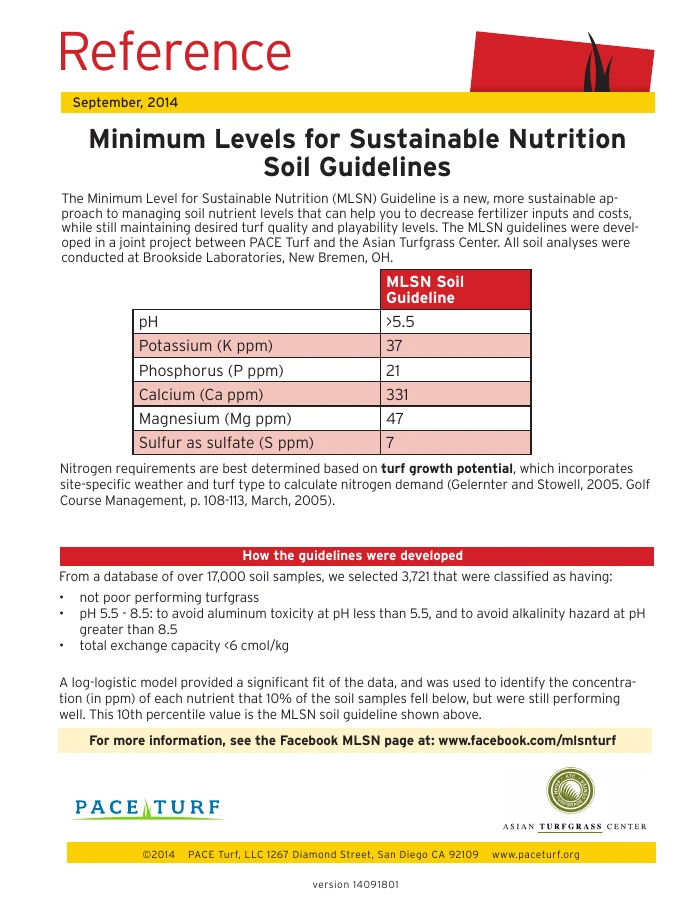 MLSN soil nutrient guidelines
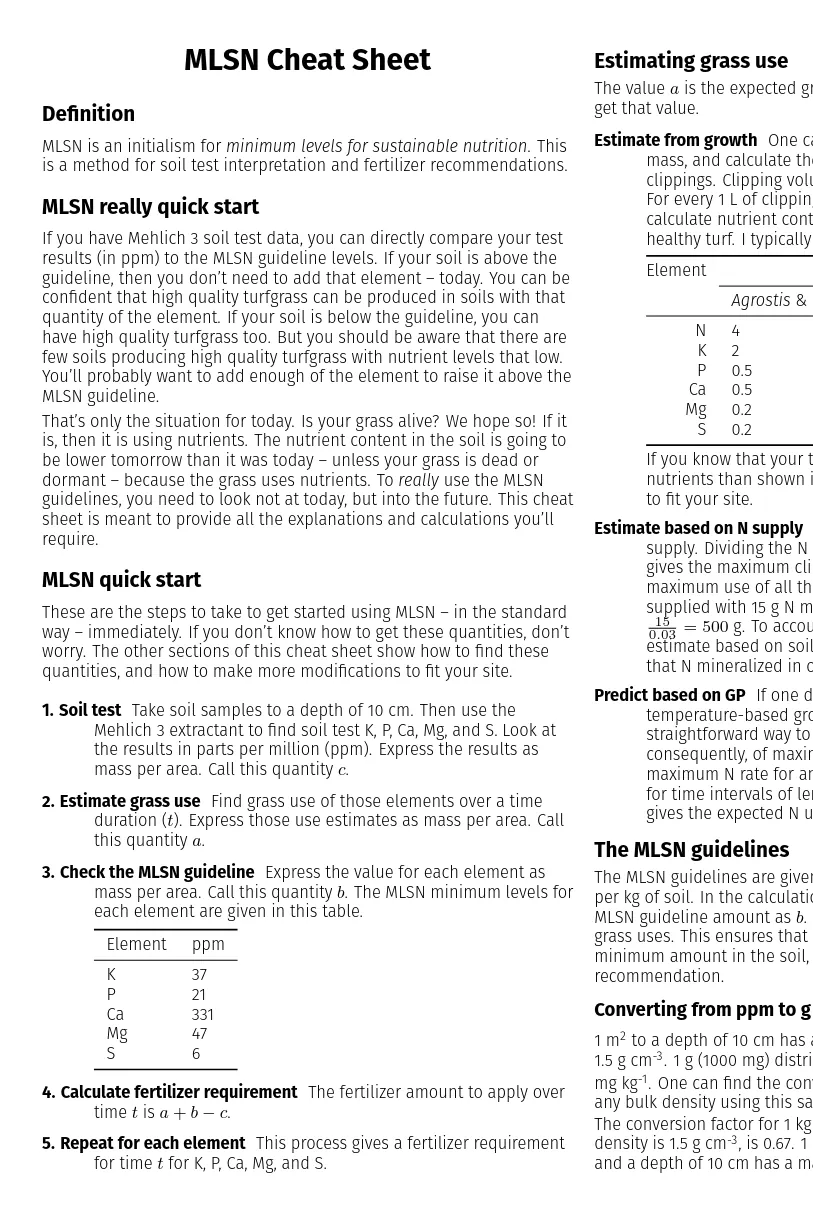 MLSN cheat sheet
 Just what the grass requires (GCM)
 The Secret MLSN Operations Manual (e-book)
 Turf Nutrition (Greenkeeper International)
 Soil Testing and MLSN: Smarter Goals, Better Results
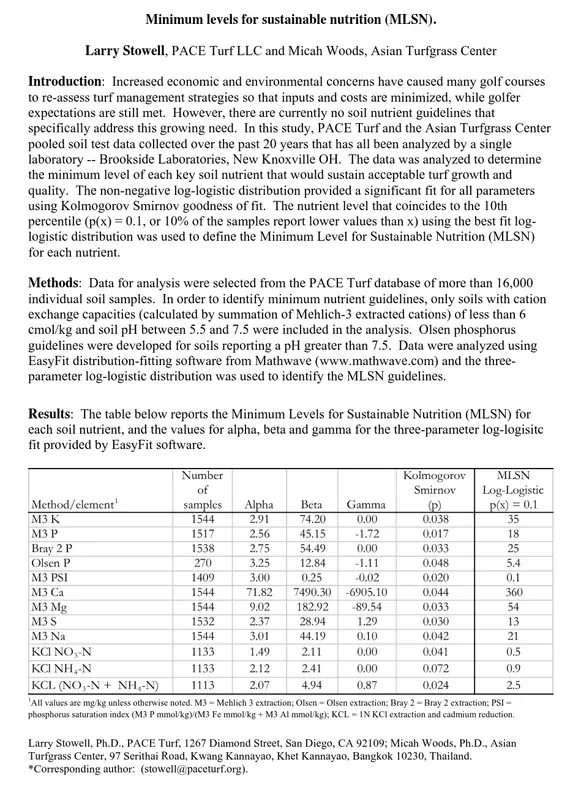 MLSN introduction (Bouyoucos Conference 2012)
 Minimum soil nutrient guidelines for turfgrass
Case studies
Pender Harbour Golf Club British Columbia, Canada
Jason Haines applied the MLSN guidelines to greens, tees, and fairways. Between 2012 and 2014, fertilizer costs fell from $4,433 to $2,276, and total product used fell from 3,085 kg to 2,301 kg. He was able to do this with little to no change in turf quality.
PACE Turf report Jason Haines blogValley Regional Park Golf Course Saskatchewan, Canada
After two years of using MLSN, Allan Dewald reduced overall fertilizer costs by about 40%. From 2015 to 2016, his actual phosphorus, potassium, and calcium rates each fell by more than half. Nitrogen rates also declined.
PACE Turf report Allan Dewald on XNewark Country Club Delaware, United States
Joe Gulotti adopted MLSN guidelines in 2017 and reported fertilizer savings of $26,447. He said the turf performed well and believed the savings helped the club survive.
Asian Turfgrass Center report Joe Gulotti blogNikanti Golf Club Nakhon Pathom, Thailand
Brad Revill reported a 69% drop in fertilizer expenses while maintaining or improving turf quality. He credits both MLSN-guided decisions and a switch to soluble fertilizers.
Brad Revill blogLas Vegas area golf course Nevada, United States
A Las Vegas golf course simplified its fertilizer program and cut annual spending from about $90,000 in 2013 to $15,751 in 2015. Most importantly, the greens have never been healthier.
USGA Green Section RecordFAQs
How do I know the nutrients are available?
You know the nutrients are available because you’ve done a soil test. That’s what a soil test is — by definition it produces a nutrient availability index. If you don’t trust the soil tests, then I suggest skipping them altogether. Instead, assume the soil can supply nothing, and supply to the grass 100% (or a little more) of its possible use of each element. This isn’t the most efficient way to do it, but you won’t need to worry about availability, and it is guaranteed to supply all that the grass can use.
MLSN guideline, target level or minimum level?
Conventional soil test interpretation may give the impression that there are target or optimum levels in the soil. The MLSN guideline is a minimum value — minimum is the M in MLSN so we haven’t always repeated that — that one doesn’t want to drop below. It’s not a level below which one will have deficiency. It’s not a target level that one ideally will have the soil at. What the MLSN guideline represents is a level in the soil with enough of that element to produce high quality turf. There is high quality turf in soils with less of that element too, and that’s why we are confident the MLSN guideline is a safe level. But there aren’t a lot of soils with less, so we suggest keeping the soil from dropping below the MLSN guideline.
Seriously, the same minimum for every grass, soil, and location? No regional customization?
We are confident that the MLSN guideline is enough to produce high quality turf for every grass, everywhere. MLSN has the ultimate customization, however, because the grass use of elements is entirely site specific. In order to ensure the soil doesn’t drop below the MLSN guideline, one has to estimate a, the expected plant use over time. That’s where the customization comes in.
How is this different than conventional soil test interpretation?
The focus of MLSN is on keeping the soil from dropping below a known safe level. To do this, one must account for how much the grass uses over time. The MLSN approach explicitly calculates the grass use. The conventional interpretation (Carrow et al., 2004) is about classifying based on soil levels.
What about micronutrients?
I don’t worry about them. They are used in tiny amounts by the grass. The grass uses about 400 times as much N as it does the most used micronutrient. The grass probably can get all the micronutrients it needs from the soil, because it uses such small quantities of them. And because it uses such small quantities of them, if you are worried about it, apply micronutrients. It doesn’t cost much and is easy to do.
What about salinity?
Salinity can kill the grass. That’s a major problem. To keep the grass from getting killed by high salinity, one needs to leach the salts from the soil. I wouldn’t worry much about soil nutrient levels or MLSN if I have a salinity problem. I would leach the salts, and I would supply 100% or a little more than the grass can use.
What if my lab uses a different soil test extraction method?
We recommend Mehlich 3 soil testing (Mehlich, 1984) when using MLSN. If you use a different soil testing method, but want to use the MLSN guidelines, you will have to convert the test results to their expected values in Mehlich 3 — or convert the MLSN guidelines to expected values in the other extractant. This conversion process introduces an unknown amount of error into the calculation.
- P
- We’ve calculated an MLSN for the Bray-2 (30 ppm) and Olsen (6 ppm) extractants. We don’t have information on other extraction methods for P.
- K, Ca, Mg
- When using 1 N ammonium acetate, or the Morgan extractant, the approximate MLSN guidelines convert to 30 ppm for K, 265 ppm for Ca, and 38 ppm for Mg. Alternatively, multiply the ammonium acetate or Morgan test results by 1.2 and then use the unmodified MLSN guideline.
- S
- No known conversion.
What is the Global Soil Survey?
The Global Soil Survey was a joint project of PACE Turf, the Asian Turfgrass Center, and turf managers around the world. Participants submitted soil samples from areas with good-performing turf. The nutrient results were added to the MLSN dataset and used to evaluate and update the guidelines. The results are reported in A survey of soil nutrient analyses from turfgrass sites in Asia, Europe, and North America.
Further reading
- MLSN paper methods, code, and data on GitHub
- Only What the Turf Needs: Updating the Minimum Levels for Sustainable Nutrition (MLSN) Guidelines
- Reduced phosphorus fertilization on golf courses: A comparison of three fertilizer recommendations for putting greens
- Comparing the effects of soil test interpretations for P and K on a creeping bentgrass putting green
- Indexing the Soil Nutrient Status of Turfgrass Systems to Develop Regional MLSN Guidelines: A Delaware Case Study