Clipping volume and center reels
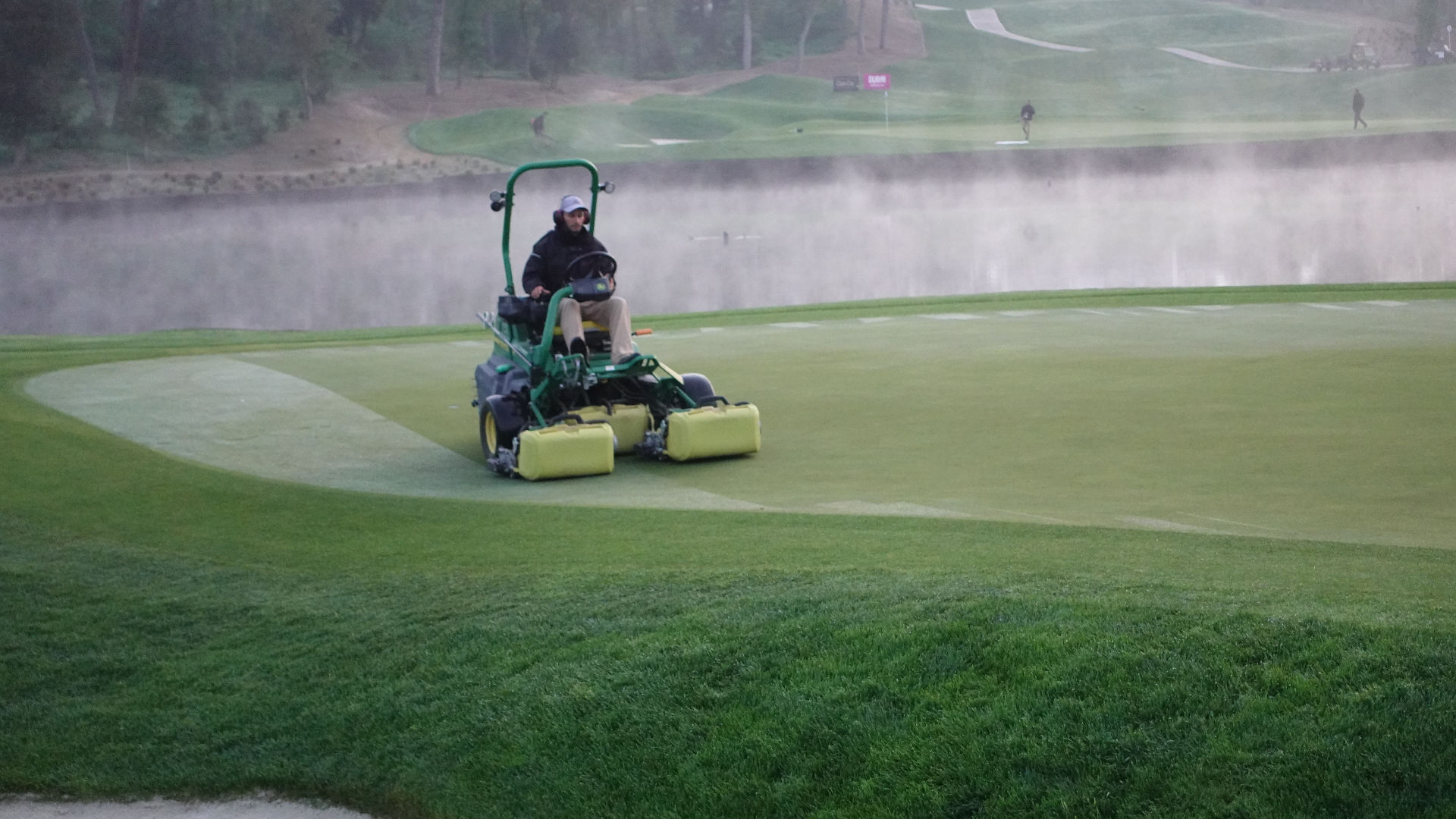 Many people have two questions about the details of collecting clipping volume with triplex mowers. Is it good enough to take the center reel’s clipping volume and multiply that by three? And should the clean-up pass clipping volume be included, or should the clean-up pass be excluded?
Our recommendation is to measure the clipping volume from all three cutting units. We also recommend including the clean-up pass.
Any consistent measurement method that produces a timeline of clipping volume will be useful, but measuring all the clippings has some advantages.
Variation between cutting units
The three cutting units will likely have different clipping volumes. If you empty the clippings from all three cutting units into the bucket, you have a chance to notice any glaring discrepancies between reels. Another benefit of measuring from all three cutting units is statistical. There’s a certain amount of variability in the clippings collected from each reel. But that variability tends to even out when you add the clipping volume from the left, center, and right cutting units. However, if you take the clipping volume from only the center reel and multiply it by three, you are taking the variability from that one reel and amplifying it. The shortcut of measuring only the center reel is three times as variable as measuring the clippings from all three baskets.
The clean-up pass
The clean-up pass is not mown every day, and I understand that the clipping volume will be considerably higher on a day when the clean-up pass is mown. Keep in mind, however, that the clipping volume on a single day is not a value we are putting much weight to. Clipping volume is looked at as a multi-day average, or as a running total through the season. We would rather have the total amount of clippings from a mown area of known size, rather than trying to smooth out the day to day clipping volume number. Use multi-day averages to smooth the clipping volume, while measuring all the clippings. That’s our recommended way to do it.
A useful equation
If you do want to find the area of the green excluding the clean-up pass, you can take the total green area and subtract the area of the clean-up pass. To find the area of the clean-up pass, you need to know the clean-up pass width and the length of the green perimeter. Call the width w and the perimeter p. Then the area of the clean-up pass will be:
wp - π**w**2
For more about clipping volume, see: