Green firmness and topdressing sand coefficient of uniformity
October 25, 2026
The coefficient of uniformity (Cu) is a value that indicates how similar the particle sizes of a material are.1 If the Cu is a larger value, there is more variation in particle size; when the Cu is a lower value, the particles are more consistent in size. A wider particle size distribution can allow smaller particles to occupy spaces between larger particles, potentially increasing packing density.
This seems to have some relevance to the firmness of a putting green, and you can find the Cu in Table 3 of the USGA’s 2018 edition of Recommendations for a Method of Putting Green Construction. The recommended ranges for Cu are 1.8–3.5 for rootzone mixtures with peat, and 2.0–3.5 for rootzones without peat. For reference, a Cu of 1.0 would be material with all particle sizes (at least in the D10 to D60 range) the same diameter.
We have collected a lot of measurements of putting green firmness and of Cu, and this chart shows something a bit disappointing, if you are trying to increase firmness by using a topdressing sand with higher Cu. The particle sizes and Cu of the sand at the 0–2 cm layer of the rootzone are a result of topdressing sand, except on the newest greens.
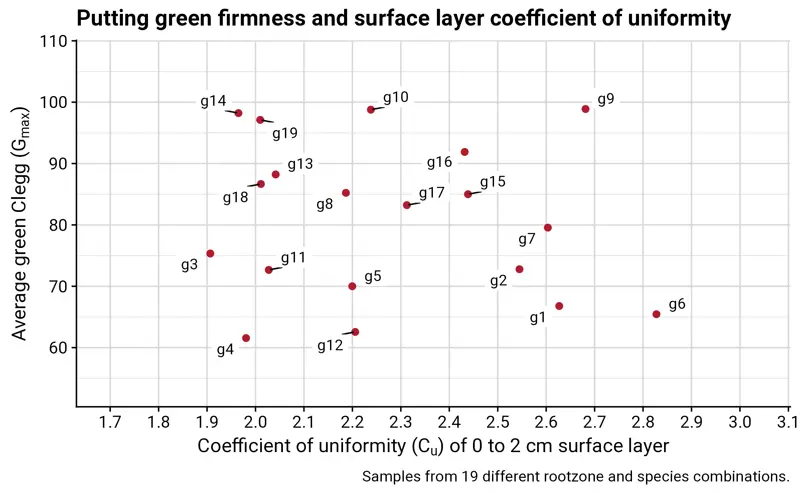
From paired Clegg (firmness) and 0–2 cm surface layer Cu measurements from 19 different greens (tested greens shown in the image below), there was no correlation between the Cu of the sand at the surface layer of the green and the surface hardness measured with the Clegg.
A higher Clegg value is firmer—on this chart a 60 or 70 is a soft green, and 100 is a somewhat firm green. If higher Cu were consistently associated with greater firmness, we would expect Clegg values to tend to increase as Cu increased. Instead, greens with similar Cu values have substantially different Clegg measurements. For example, g14 and g19 in these data have a Cu around 2 but are among the firmest greens measured in this project. g4 is one of the softest greens, and it also has a Cu around 2. If Cu influenced firmness, we would expect greens with higher Cu values to have a Clegg measurement close to 100. But again, we can have either. g9 has a Cu of about 2.7 and a Clegg near 100; g1 and g6 also have relatively high Cu, but have Clegg measurements less than 70.
Why is there no correlation between Cu and firmness in these data? At the surface of the green, the sand particles are separated, not all touching each other. The volume of organic material in the 0–2 cm layer of the rootzone takes up so much space that sand particles are displaced. The Cu of the sand doesn’t really matter when sand is packed against organic material rather than packed against sand. That’s generally the case right at the surface of a putting green.

One other thing to note—the 2018 USGA recommendation for a rootzone material is for a Cu of 1.8–3.5. In these measurements from 19 greens, the Cu is 1.91–2.83. That’s a narrow range. There is only a certain set of sand particle sizes that are suitable for topdressing. The largest particles need to work their way into the canopy, and you typically won’t be using much silt or clay or very fine sand in the regular topdressing. Fifty percent of our measurements from putting greens have a 0–2 cm layer Cu of 2.2–2.6.
Within the typical range of Cu that topdressing sands produce once that sand is on the ground, and from these tested greens, Cu doesn’t explain the firmness of the surfaces.
Footnotes
-
The coefficient of uniformity (Cu) describes the spread of particle sizes in a material. It is calculated as the ratio of D60 to D10, the particle diameters at which 60% and 10% of the sample, respectively, are finer by mass. A higher Cu generally indicates a wider particle-size distribution, while a value closer to 1 indicates a more uniform distribution. ↩