Lord Kelvin and green speed
July 12, 2026
I can’t overemphasize how much value I put on managing the growth rate of the grass. Those of you who’ve read my Short Grammar of Greenkeeping will remember this from the preface: “I define greenkeeping as managing the growth rate of the grass. If one accepts that definition, then the rest of this grammar follows logically from that.”
What follows from growth rate, as any turf manager knows, are things like mowing requirement, water requirement, nutrient requirement, thatch production, disease susceptibility, playability, sand topdressing requirement, the need to use plant growth regulators, the need to cultivate—the list goes on and on. We can manage the growth rate by feel and experience. In the end, that’s how we will do it. But we can supplement our feel and experience by putting a number to the growth rate. We can put a number to the growth rate by measuring the clipping volume.1
That’s where a famous quote2 from Lord Kelvin comes in. You may have come across Kelvin’s dictum before:
when you can measure what you are speaking about, and express it in numbers, you know something about it; but when you cannot measure it, when you cannot express it in numbers, your knowledge is of a meagre and unsatisfactory kind.
I’m not an advocate for measuring everything. Turfgrass management can proceed perfectly well with measurements of only the most important things. And again, I consider the growth rate to be the crux of the whole business.
Now let’s connect Lord Kelvin and “knowing something about” growth rate by expressing it in numbers, to the green speed. In June 2019, I spent a week in Minnesota at the Women’s PGA Championship. In June 2026, I also spent a week in Minnesota at the Women’s PGA Championship. The Championship was held at Hazeltine National Golf Club, where clipping volume was measured from the greens during both of those championships, and where green speed was measured during both of those championships.

Course superintendent Chris Tritabaugh and I discussed the green speed and the maintenance in this short video.
In 2019, the greens were cut at 0.11 inches (2.8 mm). In 2026, the greens were cut at 0.115 inches (2.9 mm).
In 2019, the greens got a single cut in the morning on Monday and Tuesday, then a double cut each morning from Wednesday through Sunday. In 2026, the greens got a single cut each morning from Monday through Sunday.
In 2019, the greens were rolled each morning after the mow (or mows). In 2026, there was no roll in the morning; there was a roll at the end of each day, after play.
We have in 2026 a higher mowing height, less mowing, and no morning rolls. But the average morning green speed I measured in 2026 was 12.8 feet. In 2019, with the lower mowing height, five double cuts, and seven morning rolls, the average morning green speed was 12.6 feet. There was also a difference in the green speed drop through the day. In 2026, the green speed I measured after play averaged 0.93 feet slower than the morning average. In 2019, the afternoon speed was 1.3 feet slower than the morning average.
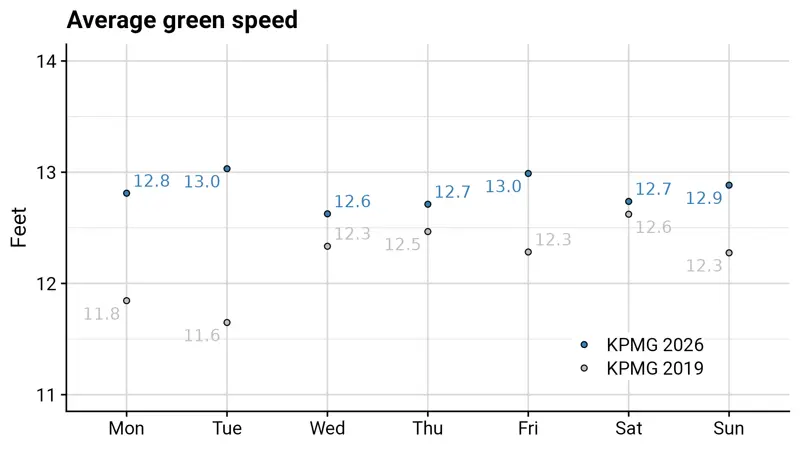
I attribute these substantial differences—faster green speed at a higher mowing height with less mowing and rolling—to the difference in growth rate. The grass was growing more during the week of the 2019 tournament, with clipping volume more than double what it was in 2026. Even on a “per mow” basis, which takes away the effect of the double cut, clipping volume in 2019 was more than 25% higher per mow than it was in 2026.
When you can measure the growth rate, when you can put a number to it, you know something about it. That knowing allows you to produce surfaces more efficiently.
Footnotes
-
Clipping volume is a direct measure of the aboveground growth rate. There are other ways to estimate growth if you don’t measure the clipping volume. I’ve written about three methods in Three simple ways to estimate nutrient removal. In short, one can measure clipping volume, can estimate clipping volume from N applied, or one can estimate clipping volume from growth potential (GP). ↩
-
There’s an extraordinary article about this quote: The Kelvin dictum and social science: An excursion into the history of an idea. An even older version with the same reasoning comes from John Arbuthnot in 1692: “There are very few things which we know; which are not capable of being reduc’d to a Mathematical Reasoning; and when they cannot, it’s a sign our Knowledge of them is very small and confus’d.” ↩