Sand and growth potential
Updated August 3, 2020
Background
In a summary of Light and Frequent Topdressing Programs written by Whitlark and Thompson, between 25 and 35 ft³ of sand per 1000 ft² is a good annual target (7.8 - 10.9 mm), but there was no site-specific recommendation on how the applications might be delivered over time depending upon environment or turf type. The 4.2 L/m² per year (4.2 mm sand per year) applied to suppress anthracnose recommended by Hempfling et. al. may not be sufficient for organic matter management in bentgrass in New Jersey or for bermudagrass grown in other locations. The initial recommended sand application rate of about 7.8 - 10.9 mm per year by Whitlark and Thompson is much lower than sand topdressing rates recommended target of 24 mm sand per year that was recommended by William Davis at the University of California in 1978. With all of these different recommendations, what’s a turf manager to do?
Adjusting by Growth Potential
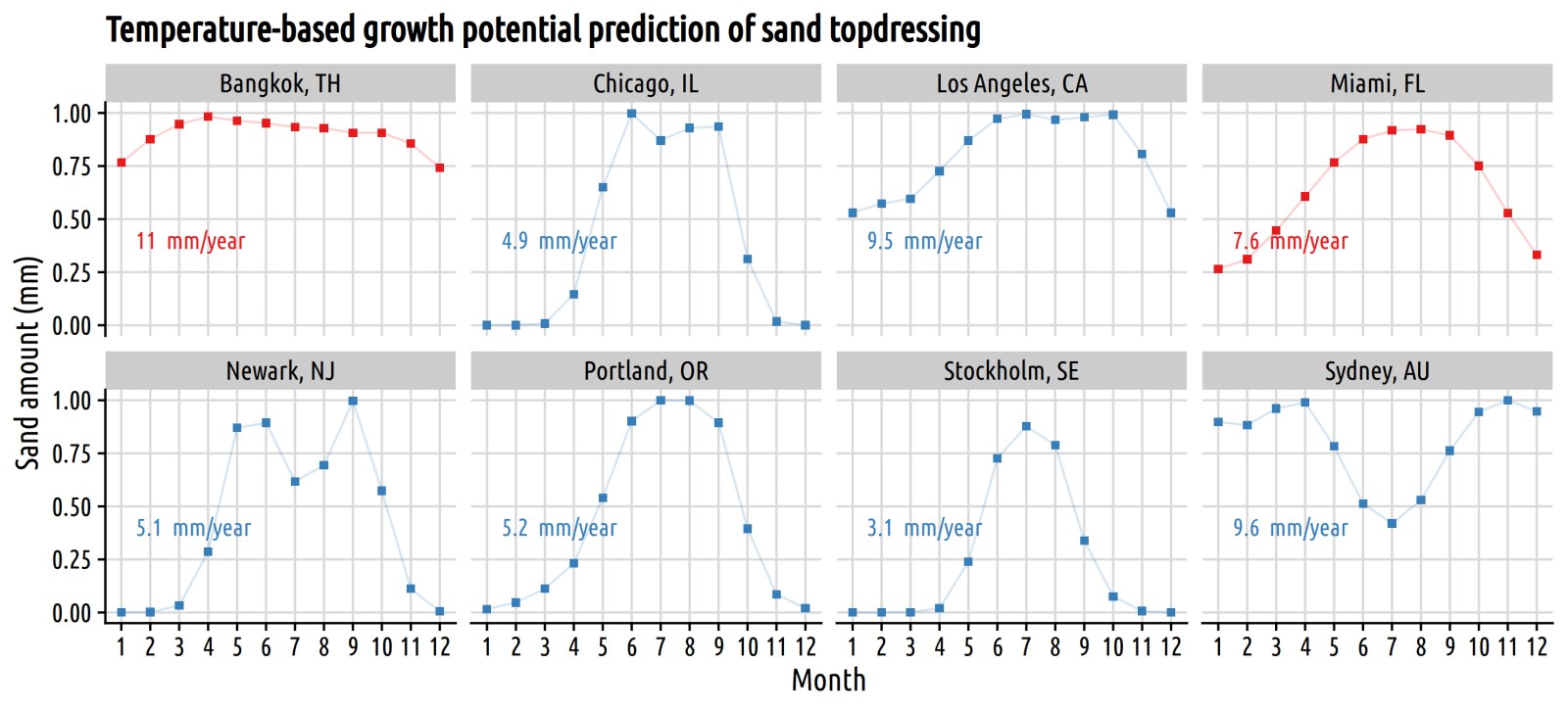
The use of Growth Potential provides a way to anticipate and budget application volumes to match turfgrass growth. Adjustments should be made to match the needs of each site depending upon the turf type, financial considerations and tolerance for sand applications by golfers. The initial values for maximum sand application are a compromise and a starting point to help you dial in the expected sand requirements for your location.
Light and frequent sand topdressing is a great tool to improve greens surface firmness, for poa greens to suppress anthracnose, and to help manage organic matter at the surface of the green. But how much sand should be applied?
Ideally, topdressing sand would be applied at a rate that matches the deposition of organic matter as leaves, stems and roots senesce and decay. To get a rough idea of how much sand to apply over the course of the year, we have developed a simple US units spreadsheet and metric units spreadsheet that use growth potential (GP) as a guide, and a maximum sand application of 300 lbs dry sand/1000 sq ft per month (150 kg/m² per month) at maximum turf growth. The spreadsheets use monthly average temperature to calculate growth potential and then growth potential to determine the sand application rate. For weekly applications, divide the monthly application rate by four.
More information
- See our update on sand topdressing and clipping volume
- Try the sand topdressing rate US units spreadsheet
- Try the sand topdressing rate metric units spreadsheet
- Reference on Turf Growth Potential (GP)
- Reference on topdressing sand
- Calculator and conversion table for sand amounts