MLSN and Precision Fertilisation
October 31, 2026
One of the questions that came up during my discussion of nutrient supply at the Swiss Greenkeepers Association autumn meeting was about an apparent discrepancy between MLSN and Sterf’s Precision Fertilisation method. Specifically, I was showing normal nutrient concentration in the dry matter of creeping bentgrass leaves, and suggesting that nutrient supply to the grass should ensure that it meets the nutrient demand of the grass. The nutrient demand is the quantity of the nutrients that the grass uses, which we get from how much the grass grows and the concentration of nutrients in the grass.
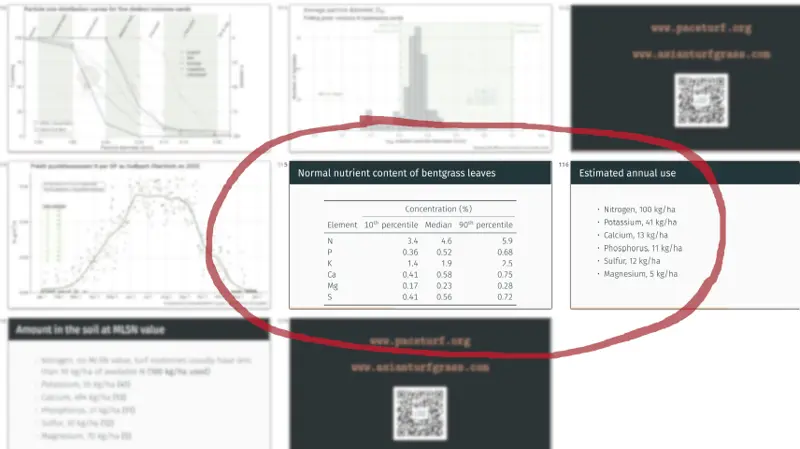
For creeping bentgrass, we expect N content of the leaves to average about 4.6% and K to average about 1.9%. For every 100 units of N used by the grass, we would expect the grass to use 41 units of K.
Sterf’s handbook says 3% N in the leaves is enough, and that very well may be. However, when we have measured the nutrient content of creeping bentgrass putting greens, we have found that the average N in the leaves is actually 4.6%. We are not saying 4.6% is enough or 3% is enough or not enough—what our 4.6% value means is this is what we expect reality to be, if we harvest clippings from creeping bentgrass over a season. This is what the grass is really using.
Table 2 in the Precision Fertilisation handbook shows that 65 units of K should be applied for every 100 units of N, while I suggested 41 units of K would be the grass requirement.
These numbers are different. I don’t see it as a problem; both methods are recommending approximately the same quantity of nutrients. You can measure the nutrients in your clippings and find out how much the grass is using, and I would expect you’d find, with multiple samples collected over time, that the nutrient content is similar to these ratios.
It turns out that when you use MLSN, the exact amounts used by the grass and the exact ratios applied as fertilizer don’t really matter. That’s because the soil supplies some nutrients, and we test the soil over time (usually once a year) to check how the nutrients are changing. The nutrient recommendations get adjusted based not only on the expected nutrient use, but also on the measured change of nutrients in the soil.